

Cupela
Year 1348 (Thirty Years Prior to Present Day)
A few days in the laboratory had been long enough. The tension in that underground facility had been stifling. Cupela had speculated at the hatred between Hrent and Piroska and how it had broken the team so thoroughly that everyone had stopped working. Then, after further examination, the real shock was that it had not occurred earlier. Without Enfildio’s presence in the lab, the long stretches of work in close proximity were too much. Even if the five herbalists had been compassionate and empathetic, which would be a generous description, they would have cracked eventually.
Her task this day was to deliver a gift to the master herbalist’s grandson, a simple but enjoyable excursion. It was always invigorating to step out into the city, even with the horrid heat of the late afternoon, and Cupela would have liked to extend her time outside as long as she could. She was aware however, that Enfildio knew the exact amount of time it took to get to his grandson’s house, and that he was more than capable of monitoring her time away from the lab while managing half a dozen other tasks. Even among geniuses, Enfildio stood out as exceptional.
His grandson lived in the wealthy neighborhood of Peridot. Each time Cupela passed through the rows of houses, each with an elaborate marble fountain to display the wealth of their owners, she pictured herself living there when her work on the immortality tonic was complete. She enjoyed fantasizing about living alone in a large house, with thousands of square feet all to herself. She did not know if she would ever be able to live with others again after the experience of being in such close quarters with five, now six, others. And she was the lucky one of Enfildio’s assistants who was allowed to leave the facility occasionally. She felt sympathy for the others, though she never mentioned it aloud. Likely they would only take her concern as gloating. No doubt they all wished to exchange roles with her and be the one who got to experience something resembling a real life, at least from time to time. Thinking on it now, she was somewhat surprised at the lack of resentment she felt from the others. Most likely this was due to their more overt issues with each other. She had no doubt that Hrent did not like her, but his hatred for Piroska provided him with an even better target for his anger, and vice versa. Ubul would never say anything in front of her, even though she believed he was thinking it. As for Jezmavalin, Cupela wondered if she actually followed the rules. If she did not, Enfildio certainly would know. Then the question became, did he choose to punish her?
Best not to think on that. A beautiful woman lives on a different plane than the rest of us. I may not like that, but it is no different anywhere else in the world. My list of issues with Jezmavalin is long enough without adding envy to the dossier.
She thought then about that awkward man who had accosted her in the library, and had then appeared with the captain of The Blades at The Roots, a bizarre coincidence which she had hardly believed. He had looked at her in a way no one had ever done before; the way all men gazed at Jezmavalin. She should have been flattered, but instead, she had felt unease. Was that what Jezmavalin experienced when all eyes were on her? The thought was laughable. That woman always appeared to relish and encourage the attention, even while feigning indifference. As for me, well, perhaps there is only one person’s admiration which I desire.
She reached her destination and strode up the pathway to the house’s entrance. The grounds were immaculately kept, as always. Enfildio paid landscapers and servants to look after the upkeep of the residence, as the boy’s parents were both deceased.
That is his reason for this project. Enfildio does not want to see another loved one die. I wonder where I would be, and what I would be doing, if his daughter and her husband still lived? It is fascinating how one event can change the trajectory of so many lives.
Enfildio had told her the story in bits and pieces. It was obvious that recalling the details and speaking them out loud was painful for the man, and so he had shared with her what he could endure during late nights when he needed companionship more than anything else.
Cupela was not sure on the exact timeframe, but based on the age of the boy, his parents could not have died more than a decade ago. Her understanding was that Enfildio’s daughter had fallen ill and her husband had blamed himself. She was unclear on whether the man had actually done something wrong, or whether his guilt was irrational. But the woman’s illness became severe enough that Enfildio had stopped working on other projects for some time in an attempt to find a cure. He failed, of course, and she died. The unknown illness took her before her thirtieth birthday. Then, it took another life. Her husband, drowning in guilt, poisoned himself.
Enfildio contacted the boy’s great aunt and brought her to the city to raise him. He would have done it himself, but he had a more important task that only he could complete. In confidence, he had told Cupela that he would never allow his grandson to die. That promise was the origin of the hidden laboratory and all the clandestine operations which now fully encompassed the lives of seven people. She hoped it would be worth it in the end, though she was not as optimistic as Enfildio.
She knocked on the door and a boy answered.
“Hello, Richard,” Cupela said as cheerfully as she could.
The boy looked up at her, and as their eyes locked, his innocent smile began to turn to a grimace. Erden was right, then. I look as poorly as I feel.
Recalling his manners, the body looked down for a moment before collecting himself and returning her smile. As usual, he was dressed in the finest new clothes, and all in black, just like his grandfather. That had been Richard’s choice. The boy idolized Enfildio, a characteristic that he shared with Cupela, she had to admit.
“Is my grandfather coming to see me today?” Richard asked.
“I’m afraid not. He just returned home and has much to attend all at once. But he did not forget you.”
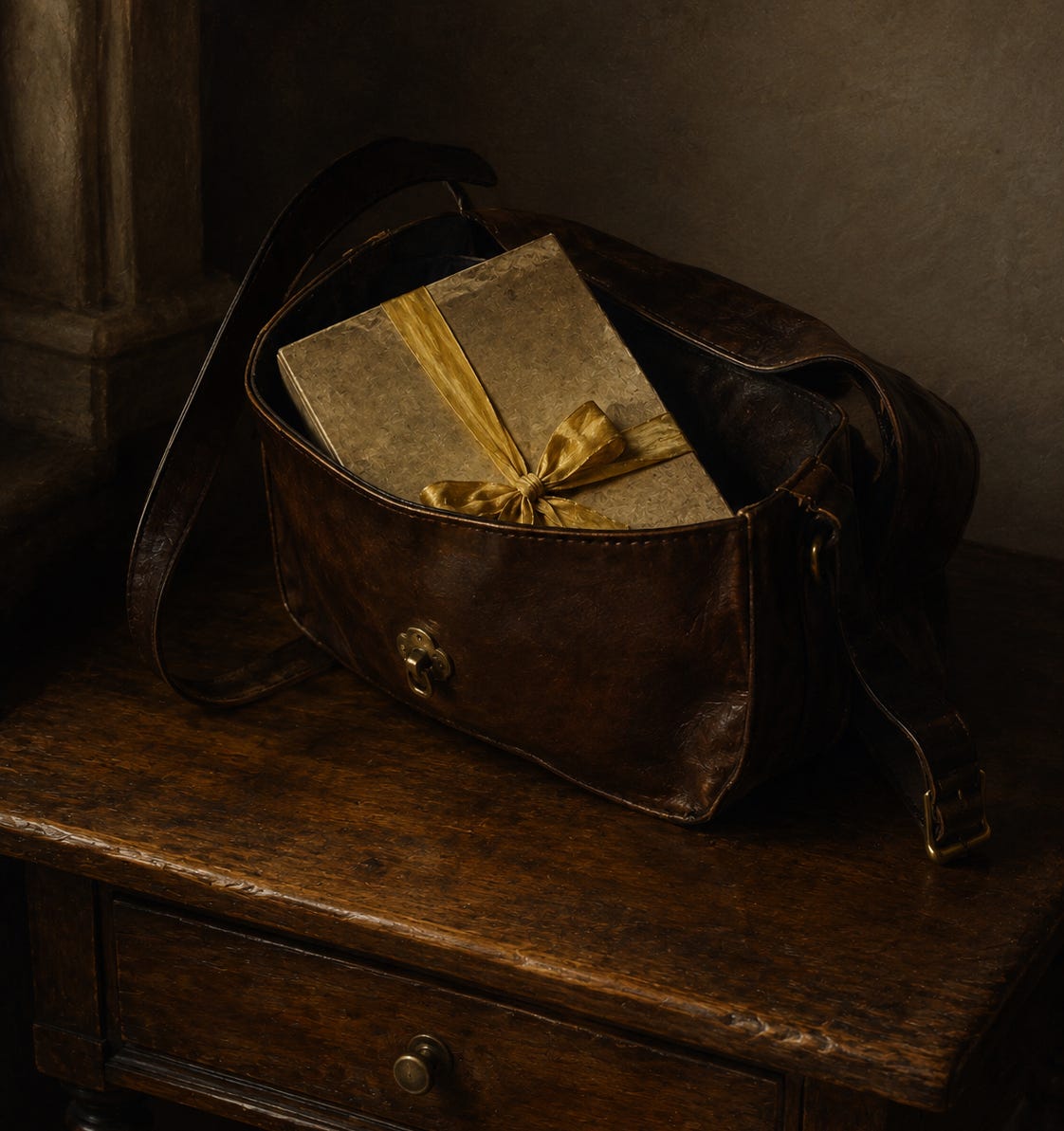
Reaching into the satchel at her side, she removed a thin, rectangular box, and passed it to Richard. The boy cocked his head slightly to the side when his eyes met the yellow bow Cupela had tied to the gift. He took the box enthusiastically and held it inches away from his face.
“I think it’s a book,” he declared.
Untying the bow and removing the top confirmed his prediction. Cupela was curious as to whether the boy knew how expensive the item was. The technology involved in printing and binding paper to a hard cover was not only new, but rare and costly. Another marvel from Enfildio’s old friend, Clarimonda. The woman is a wonder, assuming she actually created everything he claims she has.
“It’s a book on herbalism,” Richard said, flipping through the pages. The grin on his face forced Cupela to suppress a laugh. “When I grow up, I’m going to be a famous herbalist, just like my grandfather. We will work together and invent all sorts of amazing tonics. Maybe I can work with you, too,” he said looking up at her.
Divine Ones save me from remaining in the laboratory when this boy is a grown man.
“Perhaps,” she said. “What do you know of herbalism?”
The boy scrunched his face into a puzzled look. “It involves balancing the quantities of different ingredients which are mixed in intense heat.”
“Oh. I think this book will suit you quite well,” Cupela said. “Your grandfather also wants to know how your schooling is progressing.”
“It’s wonderful. My teacher, Ms. Ulfle is very nice and she knows many things. She is from northern Ebanigan though, so she complains about how hot it is here. But I like her and she allows me to play with her cats.”
Funny how children’s expertise can be so rigidly partitioned.
“Are you learning a lot? And you have been receiving high marks?”
“Yes!”
The boy looked eager for more information regarding his grandfather, but Cupela was unsure what she could say, as Enfildio had given her no order other than to deliver the package. “I have to be going now,” she said. “I’m glad you like the gift. You know your grandfather chose it especially for you.”
“I know. I’m going to read the whole thing today. Ms. Ulfle gives me one day off a week.”
That’s more than I receive from your grandfather. Though, I’m sure I make quite a bit more than Ms. Ulfle.
“That sounds like a wonderful way to pass your free time. I have something else for you which will make your reading all the more enjoyable.”
“The candies!”
Cupela laughed as she withdrew a wrapped sphere of canvas which she had kept in her satchel and handed it the boy. “From my hometown of Terizon. The sweetest treats in the world. For a sweet boy.”
“Thank you so much! This is a wonderful day!” Richard said as he looked for a way to untie the package.
“It was lovely to see you, Richard. Until next time.”
“Thank you so much for the gifts. Tell my grandfather ‘Hello’ and that I want to see him very soon.”
“I will.”
She enjoyed these visits. They reminded her of Enfildio’s softer side. Richard was a nice boy and he seemed happy, especially considering the tragedy that had befallen his parents. Whenever she would leave his residence, after dropping off a gift, giving money to his aunt (which was always done out of the boy’s sight), delivering a letter, or just checking on his well-being, Cupela wondered at the boy’s future. If Enfildio succeeded with his ambitions, the boy would have, quite literally, all the time in the world to spend with his grandfather. But if Enfildio, Cupela, and the others failed, the boy would end up passing to adulthood without having spent much time with the man he so admired, for Enfildio was always busy. If he was not in the laboratory, he was gathering ingredients, making business deals, or conducting research. He spent a small fortune on the boy, and cared for him deeply, but Cupela knew that what Richard wanted most was to be around his grandfather. She did not think Enfildio had picked up on that, and she thought it outside of her boundaries as an employee to mention it to him. Well then, just another reason we must succeed.
The errands Enfildio had her run gave Cupela the only opportunities she had to maintain her actual life, as miniscule as it was. The salary she earned was immense, and as she had no current use for the money, she sent it home to Terizon, where her seven younger siblings lived. At twenty-six years of age, Cupela was the eldest by five years, the youngest of the family but ten. Their parents had died from an influenza which had ravaged the town three years earlier. It was during that outbreak that Enfildio had discovered her.
He had tracked the illness from the port city of Tides, through Agaveton and to Terizon. He had been developing a tonic which could prevent the sickness, but the influenza spread quicker than he could create the formula, and thousands of people continued to die. He believed he had beaten the outbreak to Terizon, but he had been tragically incorrect.
Curious and highly intelligent, Cupela had taught herself to read, becoming one of the only citizens of Terizon who could do so. She had learned from copies of the town’s records when she followed her mother on her trips to clean the town hall. Her parents had been proud of her, though they did not see any practical application for her skills. Enfildio saw things differently.
Cupela had had no time to mourn, for she needed to feed her siblings. The sickness had attacked Terizon indiscriminately, taking the lives of three of the town’s councilors. Cupela stepped in to assist the remaining two councilors settle legal matters and send letters to Oslidor requesting aide. When Enfildio arrived, he was impressed that the young woman whose parents had been impoverished had taught herself to read. Over time, Cupela had grown to believe the master herbalist had also been motivated by a feeling of failure for having arrived too late to help her parents, and had seen in her the same loss he had suffered when his daughter and son-in-law had died a few years earlier. That he had taken her away from a life of poverty had forever indebted her to him. Her employment meant she could support her brothers and sisters, and so she sent them every last tenth-jewel.
The Topaz merchant district was buzzing with life at this time of day as she entered its well-worn but well-maintained streets. Cupela knew she should not be away from the workshop for long, and so she sidled past pedestrians and around carriages in a rush to her destination. Now just outside of the building, she looked up, half expecting it to have disappeared, as if she had only dreamed its existence, as she always did when she went to The Roots.
Finder answered the door, unsurprisingly, as he was the only person she had ever seen do so, regardless of the time of day or night. He gave her a short bow, and allowed her to enter. “He is at his usual table,” the man said.
She found Marshaw in the second room on the right, deep in conversation with a woman wearing a mask of dark gray with yellow adorning the edges. The two of them sat beside each other, a stack of papers, an inkwell, and a glass of brandy between them. “If I have heard nothing, then there is nothing to be concerned over. There are no records, nor any reason for suspicion.” Marshaw said to the masked woman. “You worry too much, my friend.”
He looked up and smiled at Cupela. The woman beside him may have done the same, but her face was unreadable behind the mask. She faced Marshaw again, who lightly touched her shoulder. “I do appreciate how cautious you are. But they do not allow just anyone to enter. That is a dear friend of mine. Now, is there anything else weighing on your mind?”
“Not for the moment,” the woman said as she stood. “Thank you. I will try to find comfort in my faith.”
“That is the way of it. His foresight protects us all as long as we do not waver.”
The masked woman left without another word, sliding past Cupela and through the doorway.
“I apologize if I interrupted you,” Cupela said.
“I’m rather glad for the interruption. It saved me from the same conversation I’ve been having for years. Need me for a delivery?”
“I do.”
“The same as usual?”
“Yes,” Cupela said, opening her satchel and removing a pouch of coins. “How are they doing?” she asked.
“I could tell you, or I could have them speak for themselves,” he said, leaning over. He rummaged through a bag on the floor before sitting back up and passing her a scroll.
“I don’t understand,” she said. “Who wrote this?”
“Your sister,” Marshaw said, his pride written plain on his face. “Do you know how much coin you have sent them over the years? More than enough for the youngest to pay for lessons. She wants to be like you, Cupela—a woman of letters.”
Tears began to well up in her eyes as she untied the parchment. Although she had always believed in this man who Finder had vouched for (high praise according to Enfildio) she had never known for certain whether he had delivered the money she earned. She had never wished to consider the possibility that he had been cheating her. Now she held proof of his fidelity.
She had to wipe her eyes every few sentences, and many of the words were spelled incorrectly, but she made it through the message. Her family was flourishing due to her work with Enfildio, and her sister had promised she would teach the other siblings to become literate as well. It makes the long days and nights worth it. Even if we never reach our goal, I have done this.
Marshaw waited until Cupela had retied to scroll to speak again. “My agent who makes the deliveries said your family lives in a new house now, one of the largest in the town. I hope that you are able to see it soon.”
“As do I. Alas, I am too occupied with my work to even leave the city.”
“A situation with which I am familiar. Do you wish to send a message as well?”
“I will write one,” she said, her face beaming.
She left The Roots in the best spirits she could recall, her family, and her youngest sister most of all, on her mind. Now to deal with my other family, she thought as she opened the hidden entrance to the workshop.
The gloom of the descent into the laboratory was enough to make Cupela wish she had been given more errands to run. Hrent being the first person she encountered upon entering the lab amplified that longing.
“Cupela,” he said, checking the room to see if anyone else was nearby. “What is wrong with the new girl you brought here? She hasn’t looked me in the eye once.”
“She’s incredibly shy. But she’s smart. She was the top student at The Scholar’s Guild, and the next two people she beat out were not slouches.”
“The Scholar’s Guild does not impress me,” Hrent snarled. “Perhaps a century ago it was something to preen over. The papers I have read that originated there in the recent past have been self-congratulatory drivel.”
“I may have to agree with you on that. Nevertheless, I assure you Sarah’s intellect is world class. And, I should add, if she passes Enfildio’s standards, that should be enough for you.”
The short man’s eyes narrowed ever so slightly, while making his posture as straight as possible. “Still, I thought Piroska was ugly. This new girl looks like a hybrid of a mule and an ostrich.”
“Marginalizing her before she out-performs you?”
A flash of anger across Hrent’s face. “You wouldn’t say that if you truly believed it,” he said, swiftly walking away.
Where are the others? No surprise that they wanted to be away from Hrent, but I do not see signs of anyone at all.
A cursory look around the lab found it empty, a rare occurrence. Enfildio had a separate chamber where he would work alone, but the others shared the expansive main space. Now more than ever, Enfildio’s assistants attempted to work in as isolated conditions as possible, meaning there was always someone in his or her room while others worked. It seemed unlikely that they were all in their rooms now though, especially Sarah who had just arrived and had so much to learn simply to catch up with the others.
When Cupela heard Hrent slam the door to his room, she began the second phase of her search. Starting with Jezmavalin’s room, she put her ear against the doors of each room and listened for any sign of conversation. Nothing at all. Until she reached the door to Enfildio’s living quarters.
Unlike the other herbalists, Enfildio’s private space consisted of three rooms. He had his own privy while the others shared, a personal workroom, and a bedroom. Cupela could hear voices on the other side of the door. It had been more than a year since the last time any of the assistants other than her had been in Enfildio’s private space. At least that she knew of. There was a perpetual shared skepticism regarding Jezmavalin’s comings and goings and it was not difficult for Cupela to imagine a man welcoming that woman into his personal living quarters when no one else was looking. Other than that, Enfildio had used the space sparingly to give demonstrations to the others, and even that had declined over time. It was in fact an unspoken rule of the facility that no one knock on Enfildio’s door unless there was a matter of the utmost importance. The circumstances here were strange enough that Cupela felt comfortable knocking. Or, perhaps her curiosity was such that normal constraints were not sufficient to prevent her from acting.
Laughter behind the door now. Cupela knocked a second time, louder. Enfildio opened the door and looked at her quizzically. “Yes?”
“I delivered the gift to Richard,” Cupela said, trying not to make it obvious that she was attempting to look past her employer to discover with whom he had been speaking.
“Thank you,” Enfildido said.
“Would you like me to help Sarah learn the equipment?”
Enfildio moved to the side slightly. Sarah was behind him, seated in a stool at a large desk. On the desk were tools of measurement, vials for holding liquids, a metal clamp used to extract liquid from plants, and other instruments and equipment which Cuplea had just alluded to.
“I see,” was all Cupela said in response to the revelation.
“Thank you for offering, but I think it is best if I do this myself. Here.”
“Where are the others?”
“Sleeping, I assume. Perhaps pouting, in some cases. The exertion of a full day’s work may have exhausted them, seeing as how it was the only activity in which they partook, other than arguing, for some time now.”
“I see. Well, I will continue with my research then. I’m sorry to have bothered you.”
“Not at all. Good day.”
With that, he closed the door. Cupela stood in place until she heard the talking on the other side of the door resume. Laughter again. For no reason, Cupela rubbed at her eye.