

Cupela
Year 1348 (Thirty Years Prior to Present Day)
She sat on one side of the long wooden table, Enfildio on her right, a stack of papers, an inkwell, and a quill pen between them. On the other side of the table sat the three candidates. The one who had taken the lead the night before sat in the middle. He was named Henry, and he had a confident smile which may have been endearing if it was not so omnipresent and forced. On his left sat the other young man, Visin, who followed Henry’s every move, as though he did not have a mind of his own. On Henry’s other side was the young woman, Sarah, who had only looked Cuplea in the eyes once, and had immediately withdrawn her gaze, almost as though the intimacy of eye contact had burned her.
“I thank you all again for travelling such a great distance for this opportunity,” Enfildio began. “Even here, over five thousand miles away, the reputation of the Scholar’s Guild of Hon Rin is unparalleled. Nevertheless, I would like to present to you a series of questions, so that I am sure I have the best person for the role.”
The body language of all three graduates shifted with Enfildio’s final sentence. The information they had been given had been written carefully to state that the master herbalist wished to work with the finest of the Scholar’s Guild. It had not stated that he only ever intended on giving a contract to one of the three scholars. Henry’s smile had faded, his jaw now clenched. Visin looked as though he had been told he had but one week left to live, while Sarah had taken her hands off of her lap so that they hung to her sides, her body looking lifeless.
Enfildio continued on, either indifferent to their reactions, or truly incapable of reading the room. “Cupela will be asking a series of questions ranging in subject. I would hear from each of you.” He turned an expressionless face to her then. “First question, please.”
Cupela took the top sheet of paper from the stack and flexed her hand before coating the tip of the pen with ink. She had read over the questions beforehand, practicing the inflection she would need to deliver the lines without hinting at her personal perspective. She breathed out silently, then read the first question. “How does one protect oneself from interpreting results in a way that is favorable to one’s ego?”
She looked at Visin first and nodded. Sitting up straighter, he replied, “I can think of two possible safeguards. One would be recording data solely with numbers, for numbers are less emotional than words. The other is having more than one person keeping records, which would help to temper any single set of results.”
Cupela wrote his response as quickly as she could. When she had finished, she looked to Henry. He did not hesitate. “If it is possible, the person recording the data could be separate from the rest of the study, or ignorant of what the result signified. In that case, the data would be much more likely to be free from the taint of bias.”
After writing the second answer, Cupela raised her head and waited for Sarah to speak. The young woman sat motionless in her chair, except for her mouth, her lips closed but sliding back and forth as she stared at the table. “Eventually, the person conducting the experiment will see the results, and will take from them whatever he or she is able to justify,” she said. “The trouble isn’t the numbers, or the data, it is the conclusion which is drawn. Only once the results have been implemented in a practical manner will the truth be revealed.”
The woman spoke in a monotone voice, as though she were reading, though Cupela was sure she had not truly been reciting a verse. When she finished recording Sarah’s response, she looked to Enfildio, who did not look back at her as he said, “Next question. For Henry first, this time.”
When she looked down at the second question, she paused, for it had not been one that she had reviewed. Reading quickly, she deducted that Enfildio must have written it that morning, while she was still asleep. She nearly grimaced when she imagined the expressions that would greet the question. This all passed through her mind in the span of a few heartbeats, not long enough for the room to become even more uncomfortable than it already was.
“There are many myths surrounding an army which fought with indestructible weapons and armor,” she began, knowing full well that her unease was coming through on some level. “The origin of the material varies based on the account. One states it came from within a mysterious lake, another that it was born from volcanic activity. What all accounts agree upon however, are the physical aspects of the material. It did not burn, it did not crack under pressure, it did not so much as dent or get cut by sharp objects. It was also light enough to be useful. Thus, it was employed in the crafting of weapons and armor. The soldiers who took advantage of this equipment became undefeatable and would have conquered the known world if they had not befallen a tragic fate, the details of which depend on the version of the tale you read.”
She looked up from the paper for a moment, looking over the candidates, as though she half expected they would stand up and leave as she was speaking. Confirming they remained, she finished the question. “Do you believe that such a material could exist?”
An amused look on his face, Henry sat back in his chair. “We have that story in Hon Rin as well. It is presented as a tale for children. I believe it is a lesson on hubris, more than something which should be taken literally.”
When no one spoke, he added, “It is a valuable lesson, of course. When one thinks they are invincible, that is the moment they have lost their sense of reality and are most vulnerable.”
Sarah responded more promptly this time. “There is no law that prevents the creation of an indestructible material.” Cupela waited for more, but Sarah did not feel obliged to add to her statement.
Visin, squirming in his seat, cleared his throat twice before speaking. “Pardon,” he finally got out. “I believe it is best to be skeptical of all claims until there is evidence to warrant a belief, and the more outrageous the claim, the more solid the evidence needs to be. Though, I suppose I am open to the existence of many possibilities, granted there is sufficient evidence.”
Enfildio had not said a word during all of this, and Cupela now believed he did not intend to speak until the interview was completed. A quick glance his way revealed that he was staring off into an indeterminate point. A brief sigh, and then she looked down to read the next question.
The whole ordeal lasted four bells, and left Cupela feeling drained. Enfildio had indeed remained silent for the duration of the process, which she knew had begun to agitate Henry and worry Visin. She was unable to read Sarah, and the woman’s dry responses never changed in inflection or directness. When the answers to the final question had been spoken, Cupela simply said, “That is all,” and waited for Enfildio to retake the reigns.
Without making any sort of gesture, he began speaking to the group. “Visin and Henry, I thank you for your time. I apologize for having brought you such a great distance only to send you back, but I need to be sure of certain characteristics of the people I employ. I will, of course, pay for your journey back to Hon Rin. You may wish to remain in Oslidor, however. It is a growing city, and there are many opportunities for both of you here.”
He stood up then and made a show of dusting off his top hat, which he had placed on the table at the start of the interview. “Sarah, we will speak of the terms of the employment when we are in transit. Follow me,” he said, sweeping his long, black cloak up behind him.
Cupela gathered materials as quickly as she could, and exited the room with Sarah, leaving the two young men alone at the table, dumbfounded.
She sat beside Sarah as the carriage rolled along the rough streets on its way out of the city. The woman beside her had not asked any questions, though Cupela did not know if it was due to fear or respect. She wished to put Sarah’s mind at ease, but knew in what was to come, it would be Enfildio who would need to do the speaking. The herbalist scribbled on a piece of paper and held it out for Sarah, who took it and read it without a word.
“That is the salary I offer, per year of employment.”
The young woman was shaking, and this time, Cupela knew why. She had never seen such a vast sum before. Even for a graduate of the world’s most prestigious institute of learning, to be offered such a tremendous quantity of coin, without having ever toiled a day outside of a closed environment, was startling. There would be a price to pay, however, and it was perhaps more overwhelming than the salary.
“I have no experience with herbalism,” Sarah whispered.
“I am aware,” Enfildio said. “I can teach you all that you need to know. What I require is a flexible mind of great ability. There are other requirements as well, but those will have to wait until we reach my workshop. Until then, I want you to think on what you need to live a comfortable life.”
She cannot know how literally he means that.
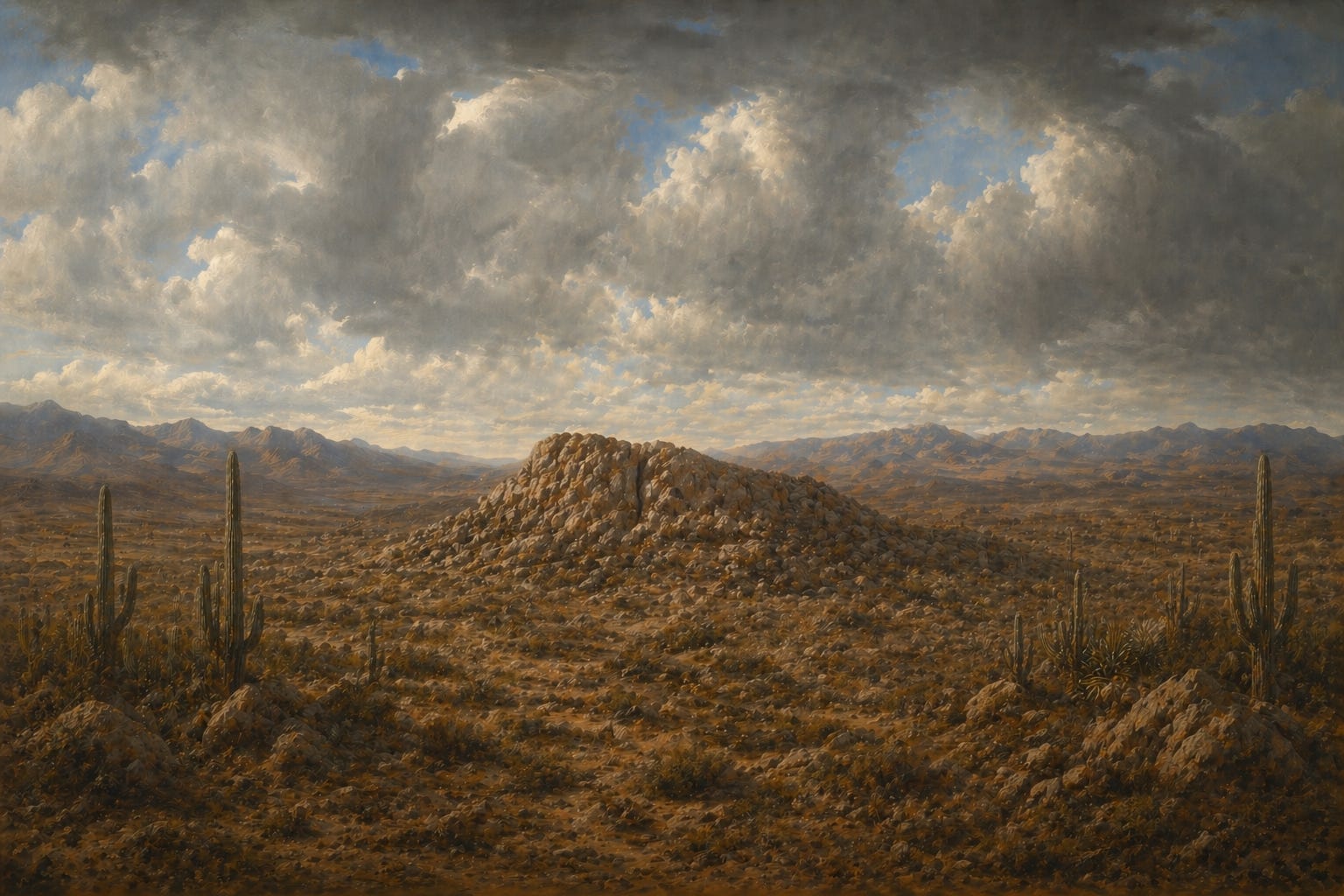
The carriage left them just south of the city. Beyond the city walls, there was nothing in sight except for cacti, rocks, sand, and a series of hills stretching out like knuckles upon the horizon. They walked in silence, each one carrying a pack. Although she was wearing the loose-fitting, white tunic which was common in the region, the heat made Cupela wipe sweat out of her eyes every fifty paces. Sarah began to lag behind, her clothing ill-suited for the climate. Ahead of them, Enfildio strode onward in his black cloak, in defiance of the elements.
After they had been traveling on foot for a third of a bell, they came within a few paces of one of the nondescript hills, roughly the size of a two-story building. At this distance, a fissure in the rock of the hill could be seen. The cut looked natural enough, and to one passing by, it would not attract undue attention. Enfildio halted to study the hill, and then the surrounding area, before placing his pack on the ground, and turned to face the two women.
“Understand that this conversation could only be held away from prying ears. Sarah, the salary which we agreed upon earlier is not accurate. You will be receiving three times that amount, annually. Why would I hide that from you? Because what I require from you is extreme. And, as you will soon see, on a scale that has never been attempted before.”
Cupela had known this speech would come. It had to, or else Sarah would not be allowed to enter the laboratory. “Sarah,” he said looking down upon her, “you do have one last chance to take another path. I can promise that you will not be physically harmed, or touched in any way during your employment. However, I will tell you, the demands placed on my employees are monumental. Most people would not accept working under these specifications. I know that, and I am content with it as well. I cannot tell you everything you need to know until you consent to work for me, no matter what I demand. What say you?”
He is not as aloof as he appears. Mentioning that she will not be touched is proof of that. He has empathy, he just chooses to be direct and efficient regardless of the circumstances.
“I consent,” Sarah said, looking up at Enfildio.
“I expected as much. You are more like me than perhaps you are aware. The contract is as such: you will receive three times the amount that I told you earlier, for each year of service that you provide. The years of service are solely dependent on the success of this endeavor, and my approval of your work. The first stipulation is that you are unable to leave the laboratory, for any reason, without my consent. Additionally, when you do leave my employment, you will not speak a word of what occurred during the time you worked for me.
It is likely that you will not exit the laboratory until the project is complete. Other than Cupela, who is my personal assistant, none of your compatriots have left the laboratory since they entered. For some, that has been more than two years.”
If Sarah was astonished by Enfildio’s words, she showed no sign of it. She had nodded twice, but otherwise had not moved.
“Know that there are spacious living quarters. You will have a private room in which you have a bed. There are shared spaces for cooking and eating, but the majority of the space is the actual laboratory where you will be working, seven days a week, sixteen bells a day, unless I say otherwise.
That is what I meant by ‘extreme.’ This level of secrecy is necessary due to the goal we are pursuing.” Enfildio paused and scanned the horizon. He slowly made a circle where he stood, peering off in every direction. Upon completion of this safeguard, he resumed speaking.
“The purpose of this laboratory is simple. We are working to develop a tonic that grants immortality.”
The words hung in the air, filling the space between the three herbalists. Cupela was relieved to have the secret revealed to Sarah. It meant she could speak to the woman more openly, without fear of hinting at something that would lead her toward information that Enfildio wanted to remain within a closed circle of people.
She remembered when the idea was first presented to her. She had already been working for Enfildio for a number of years, and had worked with him to develop herbalism tonics that enhanced human capabilities such as hearing and smell. Enfildio also had her run mundane errands for him, and when needed, care for his family who he would often forget to attend to. Herbalism was a new field, but during those first few years, it was almost mythical. People had almost no understanding of what it was, and rumors ran wild about the effects of the tonics, and the herbalists who created them. During those early days, and even now, she was enthralled to be working with someone who many considered to be the ultimate master and pioneer in the field.
The discussion of something greater than mere enhancement had been delivered by Enfildio to Cupela away from his other employees. Her first thought was that they would fail miserably. The idea of immortality seemed at best childish, and at worst delusional. But Enfildio sold her on it with his enthusiasm, his insistence on immortality being the pinnacle of human achievement, and his assurance that she was a critical piece of the puzzle.
He then informed her that he would begin seeking out other individuals who, like her, had the intellect, discipline, and dedication that the project would need. That the most ambitious of endeavors would require more than two people, was unsurprising to Cupela. She knew the amount of time that it would take to find ingredients, check variables, analyze results, and make adjustments was astronomically high. Enfildio scoured the world until he had not just one, but five capable assistants. Together, they had made remarkable progress.
“Word of this cannot reach the outside world,” Enfildio said. “If another herbalist learned what we were working on, he or she would stop at nothing to obtain our research. I mean that literally. An herbalist who believed we were closing in on immortality would not hesitate to eliminate us to acquire what we know.
After we have achieved our goal, our silence will continue. The ramifications of our success would have impacts that we cannot foresee. And on a more mundane level, we would be sought out. Hunted, in reality. I will not allow that to happen.”
Sarah’s gaze had remained steadily on the master herbalist over the course of his speech. She had stared at him, nodding and taking in his words as he explained his thinking. It was clear to Cupela that the young woman fully understood that Enfildio was not exaggerating. Their task was the most ambitious undertaking in human history.
Enfildio moved aside and gestured to the hill. “With that out of the way, welcome to your new home.”
Cupela assisted him in moving the rock. They put their hands in the fissure, then pushed to the left. The rock jerked slowly until a dark opening, roughly as large as a carriage door was revealed. Cupela stepped into the space and reached up onto the rock wall. She pulled out a torch which Enfildio lit with a flint kit that had been hidden in a recess of the wall.
The light revealed a staircase that headed underground. Once they were all behind the false door, Cupela closed it behind them and Enfilido led them down the steps. The smell of the laboratory struck Cupela harshly. A sensation of stress overtook her, the feelings overtaking her to the point where she needed to stop and place both of her hands on the handrail for a moment before continuing on. She did not believe Sarah noticed it, as Cupela was bringing up the rear. That was best, for her reaction was evidence of the monumental struggle the young woman had just entered.
The walls were solid, gray rock until they reached the ground floor. On level ground of paved stone, the walls had been fortified with wood which had been painted white to give the effect of additional light. The entirety of the laboratory and the living quarters was filled with lanterns which burned at all times of the day. The expense of the oil alone was staggering. The monetary totality of the project they were working on was more than most villages saw over the course of a century.
Doors separated the various rooms of the facility, and did an excellent job of keeping sounds from drifting from one quarter to the next. The room they were in was empty, but broke off to the left, right, and straight ahead. Enfildio lit another lantern that had gone out, a sign that either his assistants were preoccupied with their work, or had been careless in his absence.
Or, they have actually killed each other finally. Cupela thought on that. She was not sure she did not wish for it.
They passed through the doorway directly ahead of the staircase. As they walked, Enfildio began speaking again. “I will introduce you to your new family. Assuming they are all awake. I already have my suspicions regarding their work ethic while free from supervision.”
They entered the main room of the laboratory. More than double in area to most houses in the city, it also had two smaller rooms that were accessible through doors. The laboratory was well lit, with more than thirty lanterns on the walls and hanging from the ceilings. Mirrors also worked to reflect light. Although they were underground, it was as bright as noon on a sunny day. The light was quite different than sunlight however. Cupela knew it took some time to adjust to the surroundings and for one’s body to make sense of the situation it found itself in.
The floor of the room was perhaps the least cluttered area. On the tables, glass beakers were laying on their sides, some with liquid that had pooled out onto the tabletops. Papers and quill pens were scattered across every surface, some in large stacks that leaned precariously against walls or containers. The acrid stench of the room nearly made Cupela’s eyes water. The precise organization she recalled when she had pictured the room in her mind’s eye was a mocking contrast to what she now saw.
Worse, the room was void of humanity with the exception of the three individuals who had just entered, and a lone man hunched over on a stool, asleep with his face on a pile of papers.
Enfildio silently walked over to the man. He reached into his trousers’ pocket and withdrew a leather shaving strap. After a brief examination of the item, he stretched it to its limits. Then he lifted it above his head and swung it against the back of the seated man’s neck.
“Ahh!” the man screamed, reaching back to cover his neck. “Who in the Depthless Sea did that?”
He looked up and met Enfildio’s eyes.
“Enfildio!” the word was said as though it were a prayer yelled during a temple service. “You have returned.” The man looked about the room, then stood up. “Thank goodness for that.”
Cupela’s eyes narrowed. Hrent. The man was the most disingenuous person she had ever met. He would attempt to squirm his way out of this. Later, he would tell the story of this encounter in a way that would present himself in a much different light.
“Where are the others?” Enfildio asked.
“In their rooms,” Hrent answered.
“This is what you have been doing since I left?”
“No. No, of course not. We had a momentary set back. Ask the others. They will… enlighten you.”
Enfildio ran his hand down from his mouth to his chin. “Gather them,” he growled.
“This is not typical,” Cupela said, looking over at her new companion. “That was Hrent. He is not always easy to get along with, but he does work diligently. He said something happened, and I believe him. You have to understand, when brilliant, ambitious people have spent years together in isolation, it can wear on them and create tension. Enfildio keeps us all in line, but with him gone… well, we will see, but I do not expect it will be good news.”
Sarah’s eyes had widened. Cupela quickly added, “I promise you, this is an aberration. I have never seen the laboratory like this before.”
Cupela wanted to reach out and touch Sarah to help put her at ease, but she knew that gesture would have the opposite effect. Accordingly, she began tidying up while she waited for the others to return.
The procession began arriving through the door. First Ubul. Cupela considered him to be her closest thing to a friend she had among colleagues. In reality, in her whole life, seeing as though she did not have many opportunities to meet or interact with other people. Ubul was taller than the Hrent, who was well below average height, but not as tall as Enfildio, who was a few inches over six feet in stature. Both Ubul and Hrent were in their late thirties, but Ubul appeared older. His eyes were sunken in his face, but he smiled when he saw Cupela.
After Ubul, a woman who seemed to create a physical pull on the attention of the others walked through the doorway. Beautiful to the point of being unjust, Jezmavalin was a force to be reckoned with. Her slim frame was accentuated by luscious curves. Her long dark hair maintained its luster despite the conditions of the laboratory. When she sauntered past Sarah, the discrepancy in their appearance struck Cupela as viciously cruel. The recent graduate, whose gaze had been seemingly frozen to the floor, looked up at her new colleague. Cupela saw Sarah’s jaw drop ever so slightly before she quickly shifted her view back to the cold, grey stone of the laboratory.
“Enfildio,” the gorgeous woman said. “Finally you have returned. We have had need of you.”
The elderly man fought back a smile which he turned into a grimace. “I look forward to hearing about your progress.”
The next person through the door was Hrent. His arms were crossed, his expression perturbed. “She says she will be with us momentarily.”
He was, Cupela knew, speaking of Piroska. Cupela had worked in close proximity with that woman for more than two years, but she had never had a true conversation with her. Piroska spoke mostly by making demands of others, and then speaking the rest of the time to herself. Cupela had never felt even remotely comfortable around her, but she could not deny her brilliance. Enfildio had chosen his assistants based on their intellect, and in that respect, he had chosen well. Cupela was constantly struggling to stay with their thinking and not fall behind in their rapid analyzation of data and the repercussions of what they had discovered. This was, she believed, the greatest collection of minds in the world. The issues came from, well everything else about the people Enfildio had collected.
Ubul approached Cupela and put his arm on her shoulder. “It is good that you are back. Enfildio as well, sadly. The last two days have been rough. We have not made much progress. Hrent and Piroska have been at each other’s throats, and Jezmavalin has done nothing but lounge in her room. It has been trying, to say the least.”
At least a sixth of a bell passed before Piroska entered the room. That time had been spent in near total silence. Cupela had continued to clean. Ubul and Sarah had pitched in, but they had not spoken. Jazmavalin strode closer to Enfildio and had whispered in his ear. Hrent had stood motionless, arms crossed.
Piroska was a mess, as usual. Her hair shot out in multiple directions, and she was barefoot. Upon crossing the threshold of the doorway, she looked over at Hrent, then to Enfildio. “Enfildio,” she said. “You should cut your losses and kill Hrent. Our progress would double without him.”
Enfildio straightened and moved to the center of the room. “Quiet, Piroska. I will give the orders around here.
Hrent had opened his mouth before Enfildio spoke, but wisely chose to keep his comment to himself.
The master herbalist surveyed the group before him. “I do not care at all about your petty feuds. I do not care who was to blame or whose feelings were damaged. This ends now, and it will not continue. The condition of this laboratory is a disgrace. It will be back to the way it was by this time tomorrow. Also at that time, I will have a full, written report of your progress since I left.
“Your new colleague is from The Scholar’s Guild in Hon Rin. Her name is Sarah. While the laboratory is being repaired, and the report is being constructed, I will introduce her to our equipment and supplies. Do not speak to me until both of your tasks are done. Cupela,” Enfildio said, shifting toward her.
“Yes, Enfildio?”
“You will acquire a book for me, and then you will assist your companions.”
Cupela assented with a quick nod.
“The rest of you, to work, immediately. You have lost time to recover, and you will recover it quickly. Sarah, come with me.”
The new assistant followed Enfildio to a door on the right of the room. Cupela looked over the remaining people in the room. She could tell their minds were racing. Hrent’s eyes were narrowed on Piroska, who returned the look with a crazed glee in her eyes. Ubul snorted, then went over to a cabinet where various tonics were kept. He pulled out a vial of dark orange liquid, a vigor tonic. He downed the liquid in one gulp before tossing the glass vial into a basket of similarly discarded objects. “Back to business.”
Jezmavalin pushed herself up from the wall she had been leaning against. “That could have been worse,” she said, yawning.
Home at last.